
Turn out was a tad low today.
Category: Faith

Former Presiding Bishop Mark Hanson Came to Advent
He seriously is a great preacher. At the end of his sermon, we laid hands on our neighbors and prayed together. He’s one of two people I know who could get away with this. This is one of my favorite images from the day.
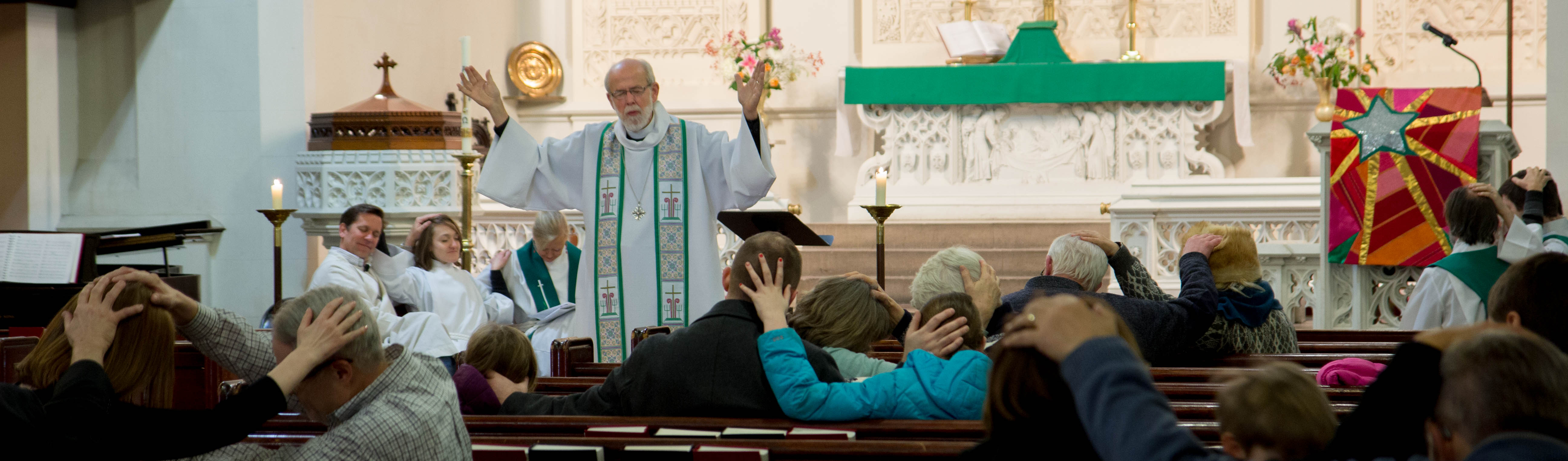
Another bonus is that he remembered meeting me. I met him first at an ELCA Fund for Leaders banquet in 2010 and then I kept going up to the microphone at the ELCA churchwide assembly in 2013. He either has an awesome memory or I just make a great impression on people.

The text is a tissue of quotations drawn from innumerable creations of culture.
 This quote, in some ways, describes why I am doing my thesis. I want to know what space & place meant in the first century hellenized world. There is meaning there – a meaning I’d like to be grafted onto. Then, I’ll be able to take my supposed placeless/spaceless world of “new media” and just see what it brings to a contemporary interpretation of Scripture.
“Writers do not magically create texts out of nothing, and readers must bring a stock of other texts and cultural codes to bear upon a writing in order to read it. In Barthes words, “The text is a tissue of quotations drawn from the innumerable creations of culture.”
From A Re-Reading of Romans: Justice, Jews, and Gentiles by Stanley K. Stowers (page 9).

What is the ELCA like?
Well, this just showed up in my facebook news feed.
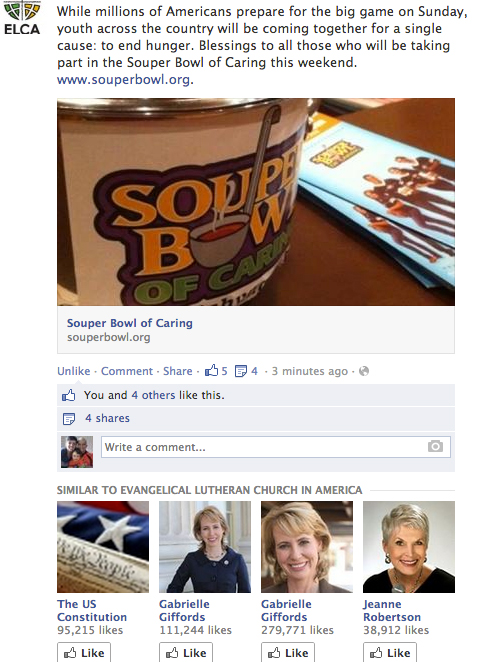
What is the ELCA like? The US Constitution, two different pages for Gabrielle Giffords, and a motivational speaker. I’m not sure how to tie all of that together.
Name Change
 I thought the ELCA changed my name on my candidacy documents. I was wrong. Yesterday, I received an email from the head of the candidacy committee connecting me with the staff person at the ELCA in charge of such things. When I married and took my wife’s last name over three years ago, I was already entranced into candidacy. At the time, I was told not to worry about it and that my paperwork will be resubmitted under my new name. It seems that didn’t happen. However, I’m impressed with how the ELCA handled my name change. They didn’t need my marriage certificate, a copy of my new passport, or a social security card. They just needed my wife’s name and date of birth. I know that I have (what feels like) dozens of forms at the churchwide offices with that information but they wanted it in email form. A few seconds of typing, a quick send, and I believe that my name change is officially taken care of at the churchwide level. That only leaves my Library Card as the last piece document in my old name. However, I was told that the NYPL doesn’t do name changes so I’ll just sit on that for awhile.

Approval Decision in a One Page Form
 A few weeks ago, I received written confirmation of my approval for ordination in the ELCA. It felt rather anti-climatic. The envelope was your standard business envelope, pre-printed with the MNYS logo in the left corner, and an American Flag forever stamp in the right. My name was spelled right (thankfully) and the address field was solid. The envelope contained two pieces of paper. One was, a lovely cover letter from the head of the candidacy committee and, the other, a one page form with the committee’s decision. That final form was just one side of the page, printed in color, and using a very boring template from Formatta Filler (which, for some reason, is still around). It is a template that, sadly, sucks the life away from its viewer. Document templates don’t need to be exciting but they shouldn’t be a blackhole for energy and feeling.
But I digress.
So, with paper in hand, I’m currently in the process of awaiting assignment. This process has been a little unnerving so far and I’m not quite sure what to write about it mostly because I don’t know yet how to wrap my head around it. The anxiety of the approval process is now matched by the anxiety of waiting for assignment after my restriction request was denied. I sit, not worried, but just anxious about what the future will bring. I trust God that it’ll work out and I will end up where I am to go but a little direction would be nice.

Introducing The Vine NYC
Friends and citizens of the internet, I give you my current project: The Vine NYC.
 Right before Christmas, Lutheran Ministries of Higher Education in NYC (LMHE) approached me, seeking help. After a short conversation, I agreed to serve as their temporary communications consultant as they launch a new model for ministry in NYC. The idea is pretty awesome. University and College ministries in NYC are shifting away from being campus-centric. Instead of focusing on on, say, Columbia University, they’re broadening their model to include multiple leaders covering the entire city. At the church I serve, Advent Lutheran, we have a dozen students from Barnard, Juilliard, Manhattan School of Music, CCNY, Fordham, etc. A ministry for them can’t be focused on only one campus. LMHE is creating a new movement called The Vine NYC. The first event, What’s Love Got to Do With It? is February 7 at Gustavus Adolphus Lutheran Church in Manhattan. I’m excited about this but I need your help.
Are you on Instgram? Follow us. On Facebook? like us. Know a college student in New York City? Tell them about The Vine and tell me who they are. Even though LMHE has been around for over 100 years, we’re starting this movement from scratch. I think this can really be an awesome resource for college kids in NYC. Help if you can!

My Life Told in Cotton
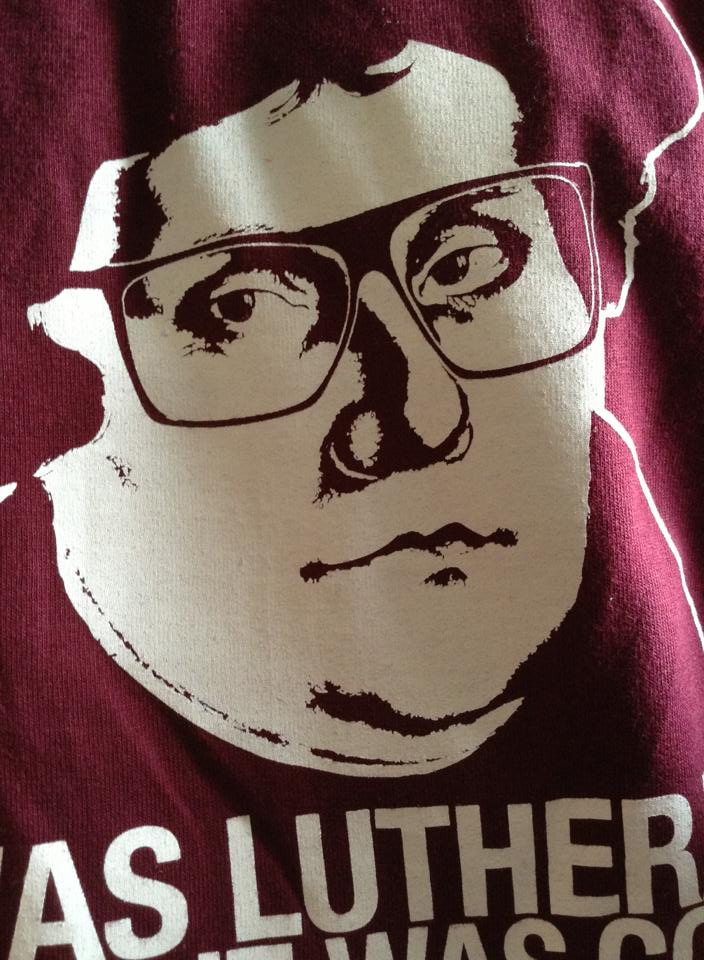 If you didn’t know, I am a t-shirt guy. While visiting my in-laws, I reflected on my experience with t-shirts. From my early days wearing Mickey Mouse T’s and being a walking billboard for Disney’s Captain EO, I spent high school stuck in T’s from Pacific Suncoast, Hot Topic, and early internet sarcasm and webcomics. Of course, you wouldn’t have seen these shirts. I was one of those punks who wore a black sweatshirt all the time. When it got cold, I just doubled those sweatshirts up. No one saw my T’s but I knew that they were there. The few times I didn’t wear my sweatshirts to school, friends were freaked out by the bit of color I wore. It just didn’t seem right to them.
In college, I started moving to band shirts but really just wore my high school clothes to death. Once I moved to the city, I was an early adopter of Threadless and bought a t-shirt at every rock and punk concert I went to. Now that I’m in seminary, Hipster Luther is my thing. My life story can be told in my collection of t-shirts. It’s possible I have one too many.

My Lutheranism in a sentence (well, make that two or three).
 On Christmas Eve, after our candlelight service, I ended up in conversation with someone who was visiting Advent for the first time. I was saying hello to a friend but, since the visitor was new, I made sure to say hi, introduce myself, and welcome her to Advent. I was robed up, sweating a bit, and the alb was a little uncomfortable. But we needed to talk so we did. She described herself as a seeker, knew the website, and wanted to know a little bit more about “all of this.” She asked for my elevator speech, for my Lutheranism-in-a-sentence take on things. I didn’t hesitate really; I just went for it. I said, “If I was going to narrow it to a sentence, I’d say we’re really focus on Christ – on Jesus – and on God taking the initiative on us and loving us. So since God loves us, now what? That’s what we explore.” I couldn’t get her to sign up for our mailing list, e-letter or like us on Facebook but she’s been at the last two Sunday services. She still won’t give us her email address but she did spend the afternoon at our large luncheon, meeting people, and talking. I saw her smile a bunch as well. Something is working here I think (and hope).